the way all reckoning does —
without announcement,
without preparation,
on an ordinary street
that did not know
it was about to mean something.
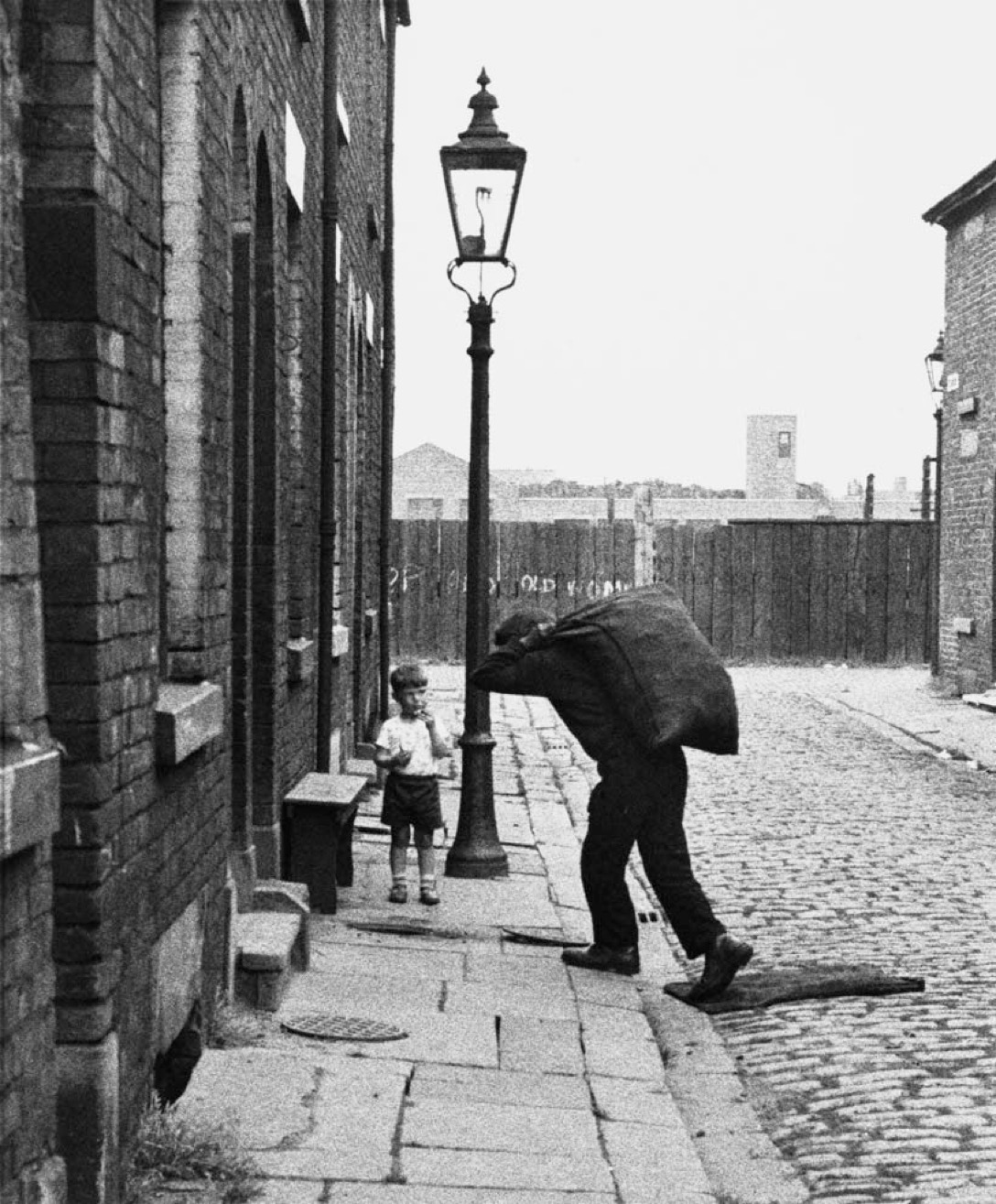
The man walks forward
because forward is the only direction
the weight allows.
The sack has its own grammar now,
its own pull on the spine,
its own way of deciding
the angle of the world.
He has forgotten
what it felt like
to stand straight
without compensating.
The boy has stopped.
Not from fear.
From that older instinct —
the one that precedes language,
that recognizes a threshold
without being able to name it.
He looks up the way you look
at weather coming,
at something large
that is not yet yours
but will be.
What does he see?
A man with a sack.
A body that has learned
to carry.
Something impressive
in the set of the shoulders,
something in the eyes
that looks like knowledge
and also, faintly,
like the place where
something used to be.
The boy is looking at his future
and the man is looking
at his origin —
that these encounters
happen everywhere,
that we spend our lives
moving between
what we have not yet become
and what we have
already surrendered.
The sack is not dramatic.
That is the important thing.
It was not placed there
all at once,
not by catastrophe
or cruelty.
It arrived the way adulthood arrives —
one reasonable thing at a time,
each addition making sense
in the moment of its taking on,
each commitment
a choice that was also
a small closing of a door
somewhere behind you
that you did not hear
because you were already
looking forward.
This geometry —
the child who watches labor
from the outside
and the man who has forgotten
he was ever on the outside.
The distance between them
is not years.
It is accumulated yeses.
What does the man see?
A body that still belongs
entirely to itself.
Legs that go at their own speed.
A face that has not yet learned
to arrange itself
for the occasion.
Not innocence —
he is too tired for sentimentality —
but something he recognizes
the way you recognize a place
you lived before the renovation,
when everything was still
unfinished and possible
and slightly inconvenient
in ways that felt like freedom.
He does not envy the boy.
Not exactly.
He knows what is coming,
knows the sack is not a punishment
but life,
knows that the weight
came attached to everything
that mattered.
But for one second,
in the particular light
of this particular street,
he would like to put it down.
Not forever.
Just long enough
to remember
what his spine felt like
before it learned
to compensate.
The boy steps aside.
The man passes.
The brick road continues
in both directions,
narrow as it always was,
wide enough for one
moving body
at a time.
Neither looks back.
Or maybe the boy does —
just once,
quickly,
the way you look
at something
you do not yet have words for
but your body
has already begun
to remember.


